
AI Rendering vs Traditional Rendering- Which Is More Efficient?
AI rendering is usually more efficient for early-stage design ideas, quick room makeovers, style exploration and client previews. Traditional 3D rendering is still stronger for controlled geometry, technical accuracy, construction-level visuals and final presentation work.
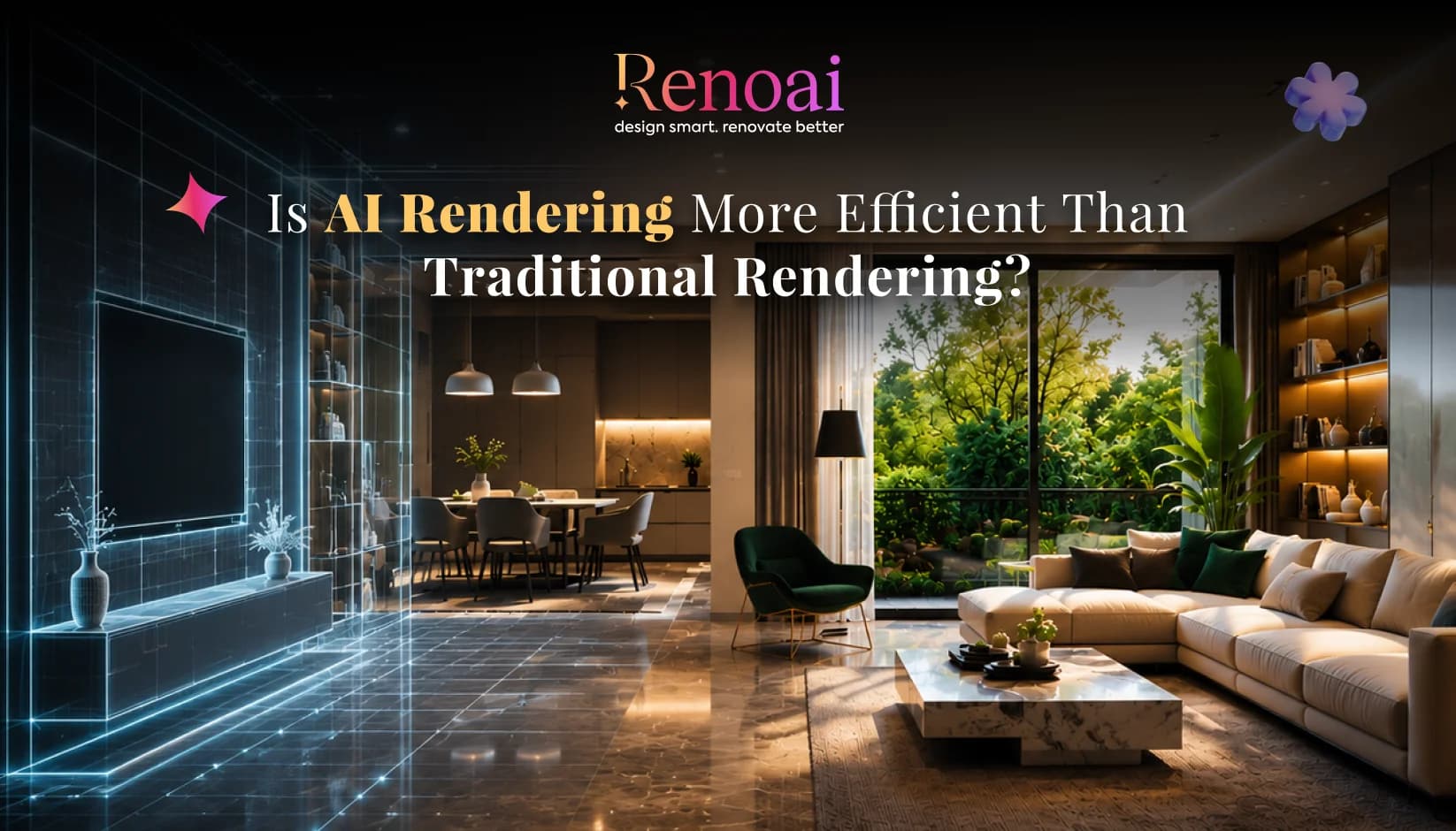
For interior designers, architects, homeowners and real estate teams, the better choice depends on the goal. Use AI rendering when you need fast visual options. Use traditional rendering when you need precision, measurement control and detailed manual refinement.
RenoAI focuses on instant AI visualization for interior design by letting users upload a room photo and generate design variations in seconds. Its platform supports interiors, exteriors, landscapes, commercial spaces, renovation previews, layout changes, staging and material exploration.
Key Takeaways
- AI rendering is faster for concept exploration and visual options.
- Traditional rendering is better for detailed, controlled 3D production.
- AI interior rendering helps test styles before buying or renovating.
- Traditional 3D rendering needs modelling, lighting, texturing and rendering.
- AI architectural rendering supports quick sketch, CAD and floorplan previews.
- AI render tools are useful for early client discussions.
- Traditional workflows remain important for final technical validation.
- The most efficient workflow often combines both methods.
What Is AI Rendering?
AI rendering is the process of using artificial intelligence to generate visual design outputs from photos, prompts, sketches, floorplans, CAD files or 3D model previews. Instead of manually building every scene from scratch, AI rendering software interprets the input and creates a visual concept quickly.
In interior design rendering, AI can help users preview furniture placement, wall colors, lighting mood, materials, layouts and design styles before making physical changes. RenoAI’s tools include Text to Render, Sketch to Render, Floorplan to Render, 3D Model to Render, Elevation to Render, Section to Render, Image to Render, Landscape Design, Upscale Images and CAD to Render.
What Is Traditional 3D Rendering?
Traditional 3D rendering is the process of generating an image from a 3D model using computer software. Autodesk describes 3D rendering software as generating images from 3D models used in architecture, design visualization, film, television, games and simulation.
It also notes that rendering adds visual details such as shading, texture mapping, shadows, reflections and motion blur.
A traditional rendering workflow usually involves-
- Creating or importing a 3D model
- Applying materials and textures
- Setting up lighting
- Adjusting camera angles
- Rendering the image
- Refining details manually
This gives designers strong control, but it takes more time than most AI render tools.
AI Rendering vs Traditional Rendering- Key Differences
| Factor | AI Rendering | Traditional 3D Rendering |
|---|---|---|
| Speed | Faster for concepts and variations | Slower but more controlled |
| Input | Photo, prompt, sketch, CAD, floorplan, model preview | 3D model or detailed scene setup |
| Best Use | Ideation, mood boards, client previews | Final renders, technical accuracy |
| Skill Level | Easier for non-technical users | Requires 3D software knowledge |
| Flexibility | Fast style testing | Precise manual control |
| Accuracy | Good for visual planning | Better for measured geometry |
| Efficiency | Strong in early design | Strong in final production |
AI rendering vs traditional rendering is not about one replacing the other completely. It is about choosing the right method for the right stage.
Is AI Rendering Better Than Traditional Rendering?
AI rendering is better when speed, idea generation and visual exploration matter more than technical precision. Traditional rendering is better when the output must match exact geometry, materials, measurements and construction details.
For example, an interior designer can use AI interior rendering to show a client five living room styles in minutes. But if the client approves one direction and needs exact cabinetry, fixture placement and material specification, a traditional 3D rendering workflow may still be required.
RenoAI also states that its designs are useful for understanding layout changes, styles, colors and spatial feel, but they are not construction-ready drawings. That makes AI rendering excellent for decision support, not a full replacement for technical documentation.
How Does AI Rendering Work for Interior Design?
AI rendering for interior design works by analyzing the user’s input, understanding the visual context and generating a realistic room concept from it. The input can be a room photo, text prompt, sketch, floorplan, CAD drawing or 3D model preview.
In RenoAI’s basic workflow, users add a space photo, choose a design direction and view final results. The platform uses the uploaded image to understand layout, lighting and proportions, then translates selected styles, colors and layout choices into visual outputs.
For realistic AI room rendering, a clear input image matters. Better lighting, visible walls, accurate room angles and uncluttered photos help the AI generate more useful results.
Read More: Top 15 Free AI Interior Design Apps for Homeowners & Designers
What Are the Advantages of AI Rendering?
The main advantage of AI rendering is speed. It helps designers, architects, homeowners and real estate teams move from idea to visual preview without waiting for a full manual 3D setup.
Key advantages include-
- Faster style exploration
- Quick before-and-after previews
- Lower effort for early concept visuals
- Easier client communication
- Better renovation confidence
- More design options in less time
- Useful support for mood boards and proposals
AI visualization for interior design is especially helpful when the goal is to compare multiple directions. A user can test minimalist, luxury, Scandinavian, rustic or coastal looks before committing to furniture, paint, lighting or renovation decisions.
Can AI Create Realistic Interior Renders?
Yes, AI can create realistic interior renders for visual planning, concept development and design communication. However, realistic does not always mean technically exact.
AI architectural rendering can show how a room, façade, landscape or interior concept may look. RenoAI’s tools can convert text prompts, sketches, floorplans, CAD drawings, elevations, sections, room images and 3D model previews into visual renderings.
The limitation is important. AI-generated visuals should be reviewed before they are used for construction, procurement or exact space planning. For professional work, designers should verify dimensions, materials, fixture specifications and structural details separately.
Read More: How Top Interior Design Firms Use AI to Standardize Visual Quality
Which Is Faster- AI Rendering or Traditional 3D Rendering?
AI rendering is faster for early-stage design exploration because it can generate visual options from simple inputs. Traditional 3D rendering is slower because it usually requires model preparation, material setup, lighting adjustment, camera placement and render processing.
For example, RenoAI’s Text to Render tool allows users to describe a space in words and generate realistic interior, exterior or architectural visuals. Its process includes writing an idea, letting AI generate visuals and downloading the chosen result for presentations or planning.
Traditional rendering is still worth the time when the final output must be accurate, branded, approved or construction-aligned.
Which Rendering Method Is More Efficient for Architects?
AI rendering for architects is more efficient during concept development, early client reviews, façade exploration and quick visual storytelling. Traditional rendering is more efficient when the architect needs full control over structure, dimensions, materials, sun studies and final presentation quality.
For architects, AI render tools can help convert early sketches, elevations, sections, CAD files and floorplans into visual concepts. RenoAI’s Sketch to Render tool, for example, analyzes lines, shapes, spatial proportions, layout flow and architectural intent before generating visual outputs.
The best workflow is hybrid- use AI for speed, then use traditional tools for precision.
Final Verdict- AI Rendering vs Traditional Rendering
AI rendering is more efficient for speed, ideation and visual communication. Traditional rendering is more efficient for accuracy, technical control and final production quality.
Choose AI rendering when you need to-
- Explore multiple design styles
- Visualize a room before renovation
- Create fast mood boards
- Present early concepts
- Test furniture, colors and lighting
Choose traditional 3D rendering when you need to-
- Produce final client-approved visuals
- Match exact measurements
- Control every material and light source
- Coordinate with technical drawings
- Prepare construction-level visual assets
For most interior designers and architects, the smartest approach is not AI rendering versus traditional rendering. It is AI rendering plus traditional rendering.
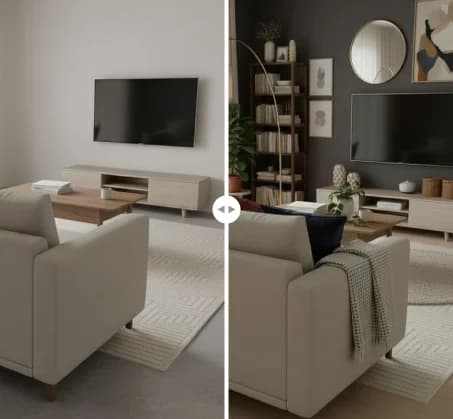
See RenoAI Come to Life in Your Space
Upload your room image and preview bold geometry, rich finishes, and timeless elegance before making any design decisions.
Preview RenoAI Now
Frequently
Asked Questions
Have questions about AI Rendering vs Traditional Rendering- Which Is More Efficient?? We answer them here
AI rendering generates visuals from prompts, photos, sketches, CAD files or floorplans, while traditional rendering creates images from manually built 3D scenes. AI is faster for concepts, while traditional rendering offers stronger control over geometry, lighting, materials and accuracy.
Start Designing with RenoAI for Free
Get 50 free credits to create up to 2 AI-generated design images in just 30 seconds.
No credit card required. No long setup. Just upload your space and start visualizing instantly.

- 50 Free Credits
- Generate up to 2 images
- No credit card required

- Unlimited design exploration
- Higher usage, faster workflow
- Built for serious design needs

Visualize Better Designs Before Making Costly Decisions
Explore realistic concepts instantly with RenoAI.
Try AI Rendering